
Trail and ultra running aren’t just about physical endurance. More often than not, they become a battle of mindset. Technical descents, long climbs, lonely hours out the back of mountains, not to mention the grueling training to test both body and mind. That’s where the concept of a growth mindset can help us all to build resilience and kick off those major goals.
I’ve recorded a video with the content from this blog (apologies for the poor audio at the start and end) and hope to be doing more of these soon.
So, what is having a Growth Mindset?
A growth mindset is a term popularised by psychologist Carol Dweck. Underlying this mindset is a strong belief that abilities and skills can be developed through effort, learning, and perseverance. The opposite is a fixed mindset, where people believe their abilities are static and unchangeable.
Compare these two statements for an example, after an athlete may have dropped out of a big race:
- “I just don’t have what it takes to complete these big races” versus,
- “Failing today was not ideal, but I learnt a strong lesson today that I need to be mentally tougher”
As you probably guessed, the first example is an example of a fixed mindset, while the second statement comes from a growth mindset.
Embracing a growth mindset can make the difference between thriving and breaking down when the going gets tough.
It’s also useful across other aspects of our lives where we can use these same approaches into work, family and life in general. Now just a word of caution on that though, I’m not suggesting you should go fully diving in here and make everything in life hard. There’s a place for toughness but don’t just assume that you should make everything a challenge. The power of a growth mindset is applying it where necessary, while you can seek out challenges and push yourself out of your comfort zone, making everything in life hard is probably not a good starting point for wading into building these skills.
So, why does it matter to our running?
Trail running is unpredictable by its nature, which is also what makes it exciting and fulfilling. You might be carving up singletrack ribbons through flowering meadows one day and then slogging through driving rain and deep mud, wondering when you’ll roll an ankle, questioning your life choices.
While you can set yourself up for success by training for all possible scenarios, this isn’t always possible. Keeping a growth mindset helps us adapt, push forward, and turn obstacles into opportunities.
So, what are the benefits?
Improved Resilience
A fixed mindset tells you that a bad race means you’re not cut out for this sport. A growth mindset sees it as a learning experience. DNFs become lessons. Injuries and setbacks become growth opportunities.
Life-long learning
Trail running is a sport of constant learning. A growth mindset allows you to see each run as a chance to improve. Whether it’s refining your nutrition strategy, dialing in pacing, or mastering technical terrain, there’s always something to get better at.
Mental Toughness
Finishing ultra races and long training runs is a huge mental achievement. The ability to reframe pain and fatigue as part of the process rather than a sign of failure is crucial. A growth mindset helps you break through mental walls instead of stopping when things get hard.
Better Motivation
A growth mindset shifts the focus from end results, like race times or podiums, to the journey. By focusing on Process Goals rather than Outcome Goals, another mental skill, you can apply the growth mindset right through your running journey.
What I mean by Process Goals is establishing small goals throughout your running and training. For instance, saying that you want to be able to “get out for a run for 3 days a week“. Or that you need “to spend 10 minutes per night doing mobility exercises 3 times a week“. By building up those small process goals rather than outcome goals you will have more opportunity to flex your achievement muscles, so that when you come to the race and its Outcome Goals such as “finish under 8 hours“, you’ve got all your process goals behind you to get to that final result.
In the meantime, celebrate those small goals, enjoy the beauty of the trails, and appreciate the progress rather than obsessing over perfection.
Cross-Skilling
Building a growth mindset is also cross-skilling for the fast-paced world of modern life. That criticism from a co-worker or boss? You can take that in your stride.
So, how can we help develop a Growth Mindset in Running?
- Reframe challenges as opportunities – Instead of dreading that tough hill repeat session, see it as a chance to build strength.
- Learn from setbacks – Instead of beating yourself up over a bad race, analyse what went wrong and how you can improve.
- Focus on progress and process goals, not perfection – Every small improvement counts. Celebrate your gains, no matter how minor. Remember the SMARTS rule for setting goals (Specific, Measurable, Achievable, Relevant, Time-Bound and Self-Defined, I will write something about this soon!)
- Surround yourself with a positive community – Fellow runners with a growth mindset can help reinforce your own.
- Write up a Growth Mindset Plan – this is a template I’ve made available to you that may help identifying where you have a fixed mindset and how you can overcome this.
- Do some further reading – The original book in this area is Carol Dweck’s “Mindset: The New Psychology of Success”, you can read a good summary here: https://fs.blog/carol-dweck-mindset/
Growth Mindset Plan
I’ve written up a template that you can use to analyse where you may have fixed vs growth mindsets, and what to do about it. This is based on Carol Dweck’s work, with some minor adjustments.
You can grab a copy of my plan in PDF here:
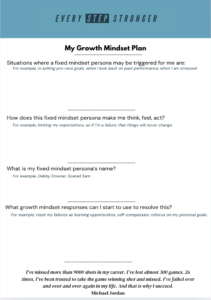
In terms of filling this in, i’ll walk through the different sections.
The first section is “Situations where a fixed mindset persona may be triggered for me are:”
In here, you may want to go through previous examples of where you’ve previously found yourself doubting yourself and thinking with a fixed lens. A classic example in running is DNF-ing or finishing outside goal time, but try and visualise your whole training process here if you can. For instance, does it trigger when you’re on a training run or before you get out of bed for a training run?
Second, “How does this fixed mindset persona make me think, feel, act?”
Here, list out the consequences of this in terms of your feelings, thoughts and actions. You’ll probably find a lot of common themes here even if you’ve listed quite a few items in the first section. We are creatures of habit after all.
Thirdly, “What is my fixed mindset persona’s name?”
Give it a name. A good example is Debbie Downer. You can use this in the heat of the moment, say to yourself “Debbie Downer is here, she’s here to tell me I need to find a new way to handle this”. By giving it a name we can help to dissolve the initial reaction, understand that it’s normal for this to happen and focus on how we can move forwards.
Lastly, “What growth mindset responses can I start to use to resolve this?”
This can be difficult to answer if you’ve not developed these previously. But to keep it simple here, we can probably start with some basic examples, such as “Restate my own goals to myself, and see this setback or hindrance as a learning opportunity to achieve that goal”, “Don’t blame circumstances or beat ourselves up, however see this as another opportunity”.
Going deeper, we can take a leaf out of a psychological technique commonly used in CBT and other therapies, Cognitive Restructuring. This would involve looking at what beliefs we may be holding us back, or cognitive errors such as black-or-white thinking or catastrophic thinking. Recognising that we may have negative beliefs such as “people who don’t finish races are weak” (false beliefs) or “I’ve failed to start one training session, this upcoming race is going to be a complete disaster” (catastrophising), we can challenge those beliefs or errors in our thought processes. For this we can use techniques such as socratic questioning, evidence gathering, pros/cons analysis, which I’ll try to cover in upcoming content.
My final thoughts
Trail and ultra running are tough, but that’s what makes them rewarding. Developing a growth mindset won’t just make you a better runner, it’ll change the way you look at training, racing and life in general. By framing things differently you’ll understand yourself and others more and hopefully enjoy the process along the way.